Quick Facts
- Decision Status: 97.3% probability of interest rate hold in June 2026 according to the CME FedWatch Tool.
- Economic Backdrop: U.S. annual inflation remains persistent at 3.8% through April 2026.
- Key Benchmarks: Effective Federal Funds Rate (EFFR) projected to remain at 3.87%.
- Geopolitical Influence: Risk of oil price shocks due to disruptions in the Strait of Hormuz affecting 20% of global flows.
- Guidance Shift: Transitioning from firm future commitments to data-dependent, Delphic communication.
- Strategy Focus: Portfolio rotation into defensive sectors and value stocks to manage fixed-income volatility.
The Federal Reserve is expected to maintain its current interest rate stance in June 2026 as inflation remains at 3.8%. This Fed rate decision reflects a cautious 'wait-and-see' approach amid murky economic signals and geopolitical risks, ensuring that price stability remains the primary mandate while the committee monitors labor market data and consumer price indices.
The June Hold: CME Data and Fed Logic
As we approach the mid-year mark of 2026, the consensus among economists and market participants has reached a rare level of synchronization. According to the CME FedWatch Tool, there is a 97.3% probability that the Federal Reserve would leave interest rates unchanged at its June policy meeting. This overwhelming market sentiment isn't just a guess; it is rooted in the hard reality of the latest economic data. Specifically, data released in May 2026 by the U.S. Bureau of Labor Statistics shows the annual inflation rate for the 12 months ending in April 2026 was 3.8%.
This persistent inflation level creates a complex environment for the FOMC press conference. Despite high nominal rates over the past cycle, the "last mile" of disinflation toward the 2.0% target in the Core PCE index has proven difficult. For long-term investors, the expected policy rate pause is more than just a momentary freeze; it represents a strategic hedge. The Federal Reserve is balancing the need to cool persistent inflation against the risk of creating too much economic slack.
Furthermore, the Fed is closely watching geopolitical developments. Any disruption to oil flows through the Strait of Hormuz could reignite energy price spikes, forcing a more hawkish signal later in the year. By choosing a hold now, the central bank preserves its fire-power for future adjustments without committing to a premature dovish pivot. Understanding this logic helps you realize that the current monetary policy stance is designed to buy time, not to signal an immediate victory over rising prices.
The Psychology of Vague Forward Guidance
In the world of central banking, what is left unsaid is often as important as the official Fed rate decision itself. We are currently witnessing a shift in how the Federal Reserve communicates its future intentions. Traditionally, central banks might use "Odyssean" guidance—naming specific dates or firm commitments for when rates will rise or fall. However, we are now firmly in an era of "Delphic" guidance. Like the ancient oracle, current central bank forward guidance is flexible, data-dependent, and intentionally vague.
This shift helps explain much of the current market volatility we see in the headlines. When the Fed avoids firm future commitments, investors are forced to react to every minor fluctuation in the jobs report or retail sales data. This leads to immediate fluctuations in bond yields and currency values as the market attempts to "guess" the next move. For the individual investor, the impact of fed rate hold on bond yields 2026 is particularly significant. Because the Fed is not providing a clear timeline for cuts, yields on longer-term Treasuries may remain elevated, reflecting an added term premium for uncertainty.
Understanding fed forward guidance for stock market timing requires a shift in mindset. Instead of looking for a specific month for a rate change, you should monitor the conditions for a change. Is the labor market cooling faster than expected? Is the Core PCE gap closing? By focusing on these indicators rather than the calendar, you can manage the psychology of the market better than the crowd. Strategic communication from the Fed is designed to keep professional traders from over-leveraging, but for the portfolio designer, it means preparing for various scenarios rather than betting on one specific outcome.
Global Impact: The Bank of Canada Comparison
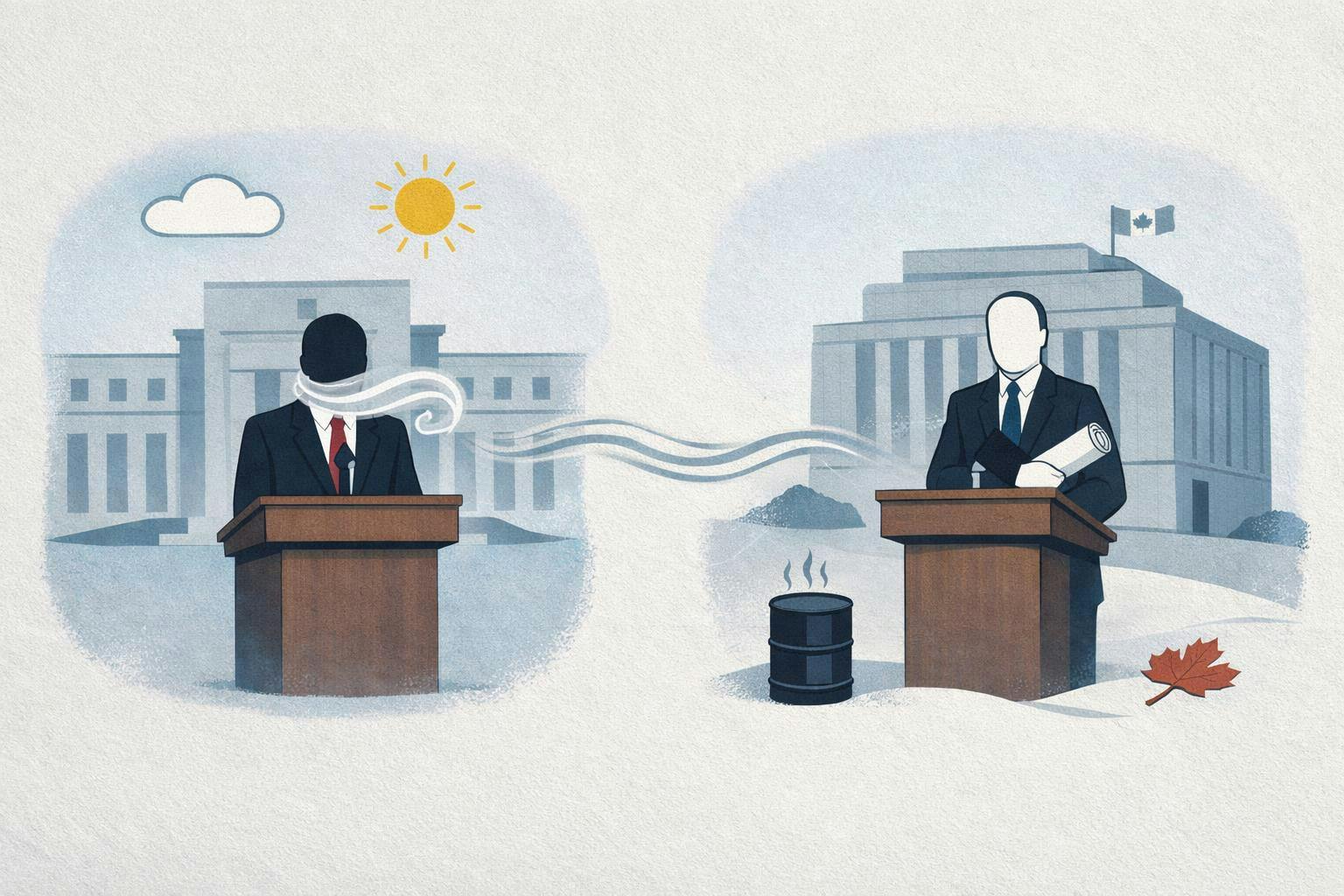
The Federal Reserve does not operate in a vacuum, and looking north provides an interesting point of comparison. The Bank of Canada rate outlook mirror's the Fed’s cautious stance in many ways. Both central banks are navigating a path where inflation is proving stickier than a simple supply-chain issue from years past. In Canada, domestic housing costs and service-sector inflation continue to weigh heavily on policy decisions.
For investors holding North American assets, the synchronized nature of these holds creates a unique currency dynamic. When both the Fed and the Bank of Canada pause, the CAD/USD exchange rate often enters a period of relative stability, provided energy prices remain steady. However, if one bank signals a dovish pivot ahead of the other, we could see sharp movements in currency valuations.
| Feature | Federal Reserve (U.S.) | Bank of Canada |
|---|---|---|
| Current Rate Stance | Data-dependent hold | Policy rate pause |
| Primary Inflation Driver | Wage growth & services | Housing & energy costs |
| Forward Guidance Style | Delphic/Vague | Transparency-focused but cautious |
| Key Risk | Fiscal deficit pressure | High household debt |
When you are rebalancing portfolios after bank of canada and fed rate decisions, it is vital to account for this macro coordination. If you hold Canadian energy stocks alongside U.S. financials, you are essentially betting that both central banks will successfully engineer a soft landing without crashing the consumer. A diversified approach helps mitigate the risk if one economy cools faster than the other.
Asset Allocation: Growth vs. Value in 2026
How should you position your assets when the Fed decides to pause? In the current environment, we are seeing a distinct sector rotation. While the first wave of AI adoption provided an incredible boost to growth-oriented tech stocks, we are now entering what some call the "second inning." In this phase, high valuations in tech are being tested by high interest rates.
Consequently, value sectors are becoming more attractive. Energy and financials often provide more stable earnings during periods of elevated interest rates. Furthermore, specific fiscal triggers like the OBBBA tax injection have provided a surprise boost to consumer staples. When the government effectively injects liquidity into the hands of consumers through tax refunds, defensive sectors like retail and household goods see stabilized demand.
As an investor, you should consider the following strategy for rebalancing:
- Increase exposure to Value: Financials benefit from wider net interest margins when rates stay higher for longer.
- Identify the best defensive sectors to hold when fed pauses rate cuts: Healthcare and consumer staples traditionally offer a buffer against market volatility.
- Maintain cash positions: High interest rates on short-term money market funds allow you to earn a safe yield while waiting for a clearer trend to emerge in the stock market.
- Monitor equity valuations: Ensure that your growth holdings (like AI and tech) are supported by actual revenue growth and not just speculative multiples.
Part of learning how to protect investment portfolio from fed rate volatility involves recognizing that the era of "easy money" is behind us. Investing during market volatility requires a focus on quality—companies with strong balance sheets to weather the interest rate cycle—rather than just growth potential.
Long-term Risks: National Debt and Leadership Change
Beyond the immediate Fed rate decision, we must look at the structural pressures mounting in the background. The U.S. is approaching a significant $40 trillion national debt threshold. This massive fiscal burden puts indirect pressure on the Federal Reserve. High interest rates make servicing this debt significantly more expensive for the Treasury, which can eventually lead to friction between fiscal and monetary policy.
Additionally, we are approaching a transition period for central bank leadership. The May 2026 appointment discussions for Jerome Powell’s successor introduce a new layer of uncertainty. Historically, leadership changes can lead to a shift in how the FOMC interprets economic slack and the price stability mandate. This can affect the term premium on bonds and may drive investors toward "debasement trades," such as gold or other hard assets.
For those of you adjusting 401k strategy during periods of persistent inflation, it is wise to maintain a long-term perspective. While short-term headlines focus on the June hold, your retirement horizon is likely measured in decades. Diversifying into inflation-protected securities (TIPS) or real estate can provide a hedge against the possibility that inflation remains structurally higher than the 2% target for the foreseeable future. Staying disciplined and avoiding short-term speculation remains your best defense against the noise of the interest rate cycle.
Technical Terminology Sidebar
To better understand the FOMC press conference and financial reports, keep these terms in mind:
- EFFR (Effective Federal Funds Rate): The volume-weighted median of overnight federal funds transactions. It is the primary benchmark for the interest rate cycle.
- SOFR (Secured Overnight Financing Rate): A broad measure of the cost of borrowing cash overnight collateralized by Treasury securities. It has replaced LIBOR in most modern contracts.
- Price Stability Mandate: The Federal Reserve's primary goal to keep inflation low and stable, usually defined as 2% over the long run.
- Hawkish vs. Dovish: A hawkish stance favors higher rates to fight inflation; a dovish stance favors lower rates to promote growth.
FAQ
How will the Fed rate decision affect the stock market?
A decision to hold interest rates often leads to increased volatility as investors parse central bank signals for future timing. In the current environment, markets are seeing a rotation from high-growth tech stocks to value sectors like energy and financials, which typically offer more stable earnings during periods of high interest rates.
What is the current federal funds rate?
As of June 2026, the Effective Federal Funds Rate (EFFR) is holding steady at 3.87%, following several months of a policy rate pause designed to curb persistent inflation.
Why does the Federal Reserve raise interest rates?
The Federal Reserve raises interest rates to cool the economy when inflation exceeds its 2% target. By making it more expensive to borrow money, the Fed aims to reduce consumer spending and business investment, thereby slowing the growth of prices.
How does the Fed's decision affect inflation?
The Fed's decision affects inflation by influencing the total demand for goods and services. A rate hold suggests the Fed believes current levels are sufficient to gradually lower inflation without causing a severe recession, though the 3.8% inflation recorded in April 2026 shows that prices can remain stubborn despite high borrowing costs.
What happens to savings accounts when the Fed raises rates?
When the Fed raises or holds rates at a high level, banks typically increase the interest rates (APY) offered on savings accounts and certificates of deposit (CDs). This allows savers to earn a higher return on their cash positions compared to periods of low interest rates.