Quick Facts
- Payback Period: AI-specific facilities currently see an average 3.5-year ROI, significantly faster than traditional real estate.
- Total CAPEX: Major hyperscalers are projected to hit an $830 billion collective infrastructure spend by 2026.
- Bottlenecks: Physical limitations like electrical grid constraints have replaced capital costs as the primary growth hurdle.
- Market Pivot: Approximately 66% of total compute usage is shifting toward AI model inference by late 2026.
- Debt Record: Global technology firms issued a $428.3 billion in bonds through late 2025 to finance expanding capacity.
- Portfolio Strategy: Mega-cap tech stocks offer a unique hedge against interest rate volatility due to superior unit economics in their AI divisions.
As the US 10-year Treasury yield hovers around term highs, mega-cap tech stocks are defying traditional logic by accelerating capital expenditures. Investment in AI data centers is surging, with hyperscalers projected to spend over $800 billion by 2026. Large cloud providers are maintaining aggressive investment in AI data centers because high revenue from AI workloads can often offset rising interest rates. With some projects estimated to recoup build costs in under four years, these strong unit economics allow mega-cap firms to justify massive capital expenditures even as the cost of borrowing for traditional projects increases.
The Financial Paradox: Why Tech Spends as Rates Rise
In a typical economic cycle, the Federal Reserve policy of keeping rates elevated would signal a cooling period for capital-heavy industries. Historically, when the US 10-year Treasury yield climbs, corporate expansion slows down as the hurdle rate for new projects becomes difficult to clear. However, we are witnessing a profound decoupling in the technology sector. While traditional sectors are retrenching, mega-cap tech stocks are doubling down. This is not reckless spending; it is a calculated capital allocation strategy based on a new generation of infrastructure that pays for itself in record time.
The scale of this shift is visible in the credit markets. Rather than relying solely on internal cash flows, global technology companies issued a record $428.3 billion in bonds through the first week of December 2025. This surge in debt issuance highlights a strategic pivot: firms are leveraging their strong balance sheets to lock in funding for AI data centers while the demand for compute remains white-hot. For these giants, the risk of under-investing and losing market share in the AI race is far greater than the risk of carrying additional debt at a 4.5% or 5% yield.
The core of this paradox lies in understanding ai data center roi metrics for investors. A traditional data center might take seven to ten years to reach profitability. In contrast, hyperscale AI facilities, often fully contracted before the first stone is laid, are seeing a 3.5-year payback period. When an asset generates such high-margin cash flow so quickly, it renders moderate interest rate fluctuations secondary to the speed of deployment.
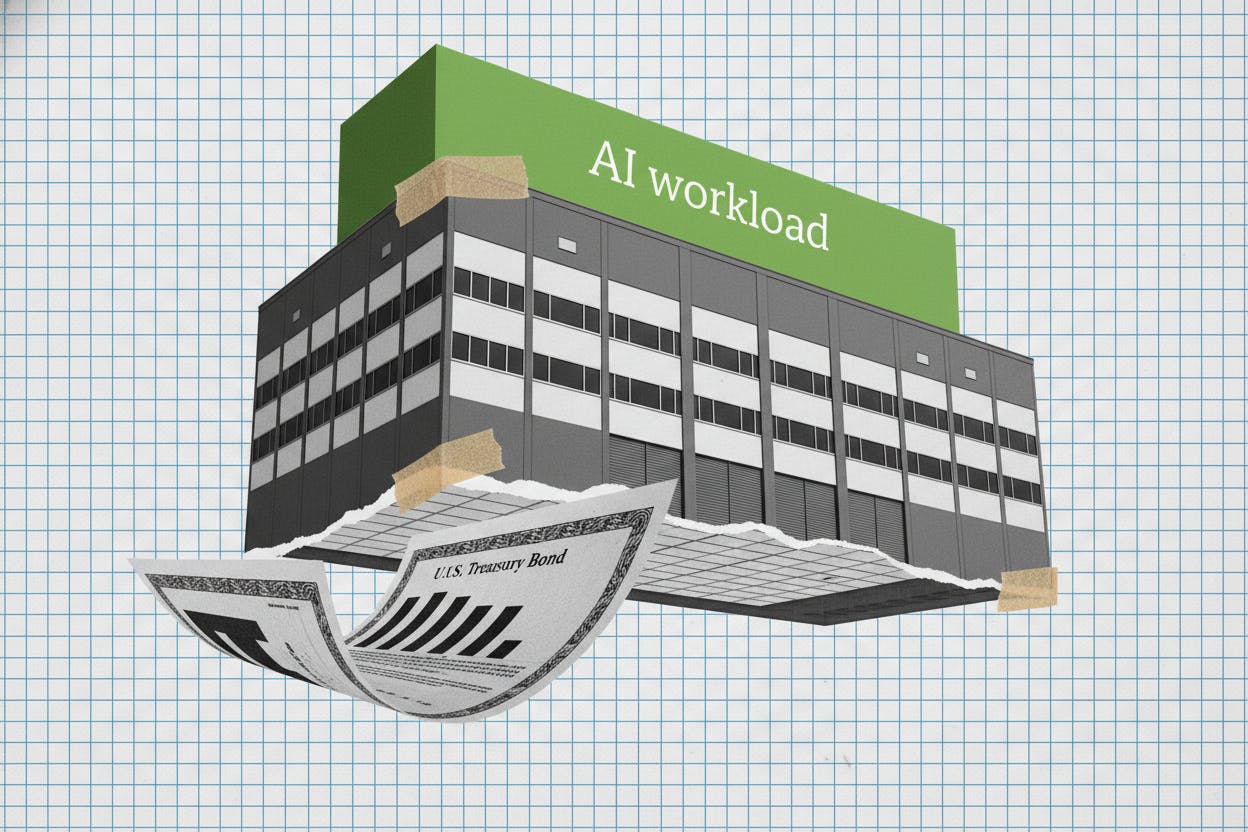
This aggressive posture is most evident when comparing hyperscaler cash flow to ai infrastructure debt. While smaller firms might struggle with debt service, the "Big Four" have increased their combined capital expenditures from $151 billion in 2024 to more than $400 billion in 2025. This spending supports a massive build-out of hardware infrastructure and specialized cooling systems required for the next generation of chips.
The Shift to Inference: Hyperscaler CAPEX Allocation
As we move deeper into 2026, the nature of hyperscaler data center spending is evolving. The initial phase of the AI boom was defined by "training"—massive clusters of GPUs working for months to build a single model. We are now entering the "inference" phase, where those models are put to work answering billions of user queries in real-time. Industry data suggests that 66% of compute capacity is now shifting toward AI model inference. For investors, this represents a transition from speculative R&D to a utility-like revenue model.
| Company | 2024 CAPEX (Actual/Est) | 2025 CAPEX (Planned) | 2026 CAPEX (Projected) |
|---|---|---|---|
| Microsoft | ~$50B | ~$80B | ~$110B |
| Alphabet | ~$38B | ~$58B | ~$75B |
| Amazon (AWS) | ~$53B | ~$75B | ~$95B |
| Meta | ~$35B | ~$42B | ~$55B |
| Oracle | ~$7B | ~$12B | ~$20B |
This table illustrates the staggering trajectory of hyperscaler capex allocation for ai vs traditional cloud. Note that the growth is not linear but exponential, driven by the need for advanced packaging semiconductors and specialized high-density racks. This level of Cloud infrastructure scaling is unprecedented. When we evaluate tech stock selection criteria in high interest rate environments, the ability to fund this level of growth through a mix of high-margin revenue and strategic debt issuance becomes the primary differentiator between winners and laggards.
Brick, Mortar, and Power: The Pick-and-Shovel Infrastructure
While capital is abundant for the largest players, physical constraints are becoming the new bottleneck. We are no longer just looking at a shortage of chips; we are looking at a shortage of power. Building AI data centers requires a massive overhaul of existing utility frameworks. Some estimates put the cost of the AI build-out at nearly $45 billion to $50 billion per gigawatt of capacity.
The limitations of the electrical grid constraints are already impacting timelines. For example, Azure’s reported $80 billion backlog is tied as much to power availability as it is to hardware supply. To solve this, companies are investing in liquid cooling solutions and next-gen GPUs that offer higher performance per watt. These are no longer "nice-to-have" features; they are essential for packing enough compute density into a facility to justify the high real estate costs.
When evaluating azure and aws power constraint impact on growth, investors must look beyond the quarterly earnings. The "winners" will be those who can secure long-term energy contracts, sometimes involving on-site nuclear or geothermal power, to bypass the aging public grid. This physical infrastructure layer adds a "moat" to the business that didn't exist in the software-only era.
Risks of Obsolescence and Rising Yields
Despite the optimism, my role as a strategy editor is to highlight the divergence in the market. While the cash-rich giants can weather the storm, more leveraged players are feeling the heat. Specifically, data center REIT investment risks are rising. Real estate investment trusts often rely on heavy borrowing for construction, and unlike a hyperscaler, they may not have the luxury of $100 billion in annual free cash flow to cushion the blow of rising yields.
The risks of data center reits during rising borrowing costs include compressed margins and more difficult refinancing conditions. As real estate capitalization rates adjust to a higher-for-longer rate environment, the spread between the cost of capital and the rental yield of a data center narrows. If a REIT is stuck with older facilities that cannot handle the power density of modern AI hardware, they face a double threat: rising debt costs and a shortening hardware lifecycle that could render their assets obsolete before they are fully depreciated.
Furthermore, investors must monitor fixed-income volatility. If the Federal Reserve is forced to keep rates higher for longer than the market expects, even the strongest tech stocks may see their valuations pressured, even if their operational AI infrastructure ROI remains high. The "Stargate" sized projects—referring to the rumored $100 billion to $500 billion supercomputer clusters—require a multi-year horizon that assumes a stable economic backdrop.
FAQ
How do AI data centers differ from traditional data centers?
AI data centers are designed for much higher power density and heat output compared to traditional facilities. While a standard data center rack might use 5 to 10 kilowatts of power, an AI-ready rack containing high-end GPUs can require 50 to 100 kilowatts or more. This necessitates advanced cooling systems, often involving liquid-to-chip cooling, rather than simple air conditioning. Additionally, AI centers require high-bandwidth networking to allow thousands of chips to work together as a single unit.
Why do AI data centers require so much power?
The processors used for AI, such as modern GPUs and TPUs, perform millions of complex mathematical operations per second to train or run large language models. This intense computational activity generates significant heat and consumes vast amounts of electricity. Beyond the chips themselves, the cooling systems and support infrastructure also require substantial energy, making the total power draw for a single large facility equivalent to that of a small city.
How much does it cost to build an AI data center?
The cost of building a state-of-the-art AI facility has escalated significantly. Current estimates range from $45 billion to $50 billion per gigawatt of power capacity. A single hyperscale facility can easily cost several billion dollars including the specialized shell, electrical infrastructure, cooling systems, and the actual computer hardware, which represents the largest portion of the total expenditure.
What hardware is used in AI data centers?
The core hardware includes specialized AI accelerators like NVIDIA's H100 or B200 GPUs, Google’s TPUs, or Amazon’s Trainium chips. These are supported by high-speed networking fabrics, high-performance solid-state storage, and advanced power distribution units. Because these components run so hot, liquid cooling manifolds and heat exchangers are increasingly becoming standard hardware requirements in these environments.
Which companies are leading the AI data center market?
The market is dominated by hyperscalers including Microsoft, Amazon (AWS), Alphabet (Google Cloud), and Meta. These firms account for the majority of global capital expenditure. Other significant players include specialized cloud providers like Oracle and CoreWeave, as well as the infrastructure providers and semiconductor firms that supply the underlying technology.
Portfolio Strategy: Navigating the 2026 Landscape
As we look toward the 2026 fiscal year, the narrative for long-term investors remains one of selective participation. Mega-cap tech stocks have proven that they are not just software companies; they are the new industrial giants of the digital age. By owning the physical pipes and the power that runs the AI economy, they are building a durable competitive advantage.
For a balanced portfolio, tech stock selection criteria in high interest rate environments should prioritize companies with low net debt-to-EBITDA ratios and high internal rates of return on their capital projects. The ability to generate a 3.5-year ROI on a $10 billion data center is a rare feat in any economic environment, let alone one with 5% interest rates. While we must remain vigilant regarding grid bottlenecks and potential oversupply in the long run, the current phase of the AI cycle belongs to those who have the capital and the courage to build. Focusing on names that can self-fund their growth while maintaining aggressive AI data centers expansion remains the most prudent path for growth-oriented investors.